Showing posts with label poetry. Show all posts

Tuesday, October 03, 2017

A Poem and an Explanation...

Jimmy Carter at the opening of his Sunday School class
It's been two weeks since I've blogged (or caught up with the blogs of others).  I am not sure why for I haven't been that busy.  But the weather is cooler and I have taken long walks in the evening.  Other evenings I've spent watching Ken Burn's "The Vietnam War" and reading.  Among the books I've been reading has been Diarmaid MacCullouch's The Reformation; David McCullough's The Wright Brothers, Michael Herr's Dispatches (If  you're interested in Vietnam from the soldier's POV, read it); Archibald Ruthledge's Peace in the Heart; and several books of poetry including Anya Krugovoy Silver's Second Bloom.  The other night, I began the poem below after reading a chapter in Ruthledge's book and a number of Silver's poems.  

I still have several drafts of blogs I need to finish and post from my trip in June/July to Scotland, as well as my experiences this weekend as we visited Plains and Andersonville, Georgia.  On Sunday, we were in Jimmy Carter's Sunday School. It was a treat and exceeded my expectations even though we arrived early (6 AM) while it was still dark.  As I joked, I don't normally go to Baptist churches but when I do, it's under the cover of darkness and a former President is teaching Sunday School.  (It was also Jimmy Carter's birthday so in a way I felt that I along with a few hundred other folks crashed his party).  Now for the poem: 


Resurrection

There is a section in the Hastings Cemetery where children who died during or before birth are buried.  This area is at the back corner of the cemetery, on a ledge overlooking the river. A few years ago during a spring flood, some of the graves were lost to the Thornapple, a river that flows into the Grand and then in Lake Michigan as its waters make its way to the sea.


Bury me with the children who died prematurely
and planted in simple graves, at the back of the cemetery,
far from the gaze of the mourner, ‘cept broken-hearted parents.

Bury me under a huge sycamore,
whose broad leaves shade the ground in summer
and white bark appears ghostly on a foggy morn.

Bury me where the river makes its sharp bend
its swift waters carving into the bank.
There, I can hear the river’s call as it rushes past. 

Bury me close to the ledge where in a few years or maybe a century,
a spring flood will free me and those kids
and I’ll lead them on a grand adventure.

In our box boats we’ll shoot through the gates of the Middleville and Irving dams,
forgetting the dangers for it no longer matters to the dead.
We’ll laugh as we catch an eddy below and float in circles.

At Alaska, the village-not the state, we’ll shoot the rapids
and when we meet the Grand we’ll chat with those fishing for salmon
and wave to the pedestrians on the bridges at Grand Rapids.

I hope it is night, with waves breaking over the piercing lighthouse,
when we leave the river at Holland, for the lake.  We’ll then float more slowly
watching the lights on shore fade from sight as we navigate by the north star.

Time will slow as we slip from one lake to another
and over those falls at Niagara that terrify all but the dead,
before making our way into Canada and down that great waterway.

And years later, if our wooden boats hold up, we’ll slip out the St. Lawrence
and into the cold waters of the North Atlantic along with ice bergs,
riding the Gulf Stream as it heads north and then east and back south.

We’ll bed down with wintering puffins
and watch whales play as they ply the sea, while we pass
Iceland and the Faroes, Scotland and Ireland, and on beyond the Azores.

Bury me with the children, in the back of the cemetery,
And in time the river will call and we’ll float
to where peaceful waters gather. 


-jg  September 2017

Thursday, January 01, 2015

Swamp Seduction

Happy New Year everyone!  Last night, I returned from a three day/two night solo paddle in the Okefenokee Swamp.  It was an incredible time.  In the watery prairies on the northeast section of the swamp (I began my trip at Kingfisher Landing) there were incredible numbers of pitcher plants from last summer, slowly dying but still glorious.  Having a long time to ponder the plants, I penned this short refection.  The pitcher plant is carnivorous, eating insects (of which there are plenty in the swamp) that explore their dark depths.   Freud would have a field day with this...  


Swamp seduction

Huddled together like whores on a sidewalk,
red polka dotted capes atop graceful lines
shield slender bodies from the sun and rain,
while luring the unsuspected to peek
into the face of the cobra.
Not sensing the danger,
her fragrance and the desire of sweeter nectar,
draws us happily down the dark canal
where few return.

Postscript (January 2, 2014).  In the last paragraph of Megan Kate Nelson's book, Trembling Earth: A Cultural History of the Okefenokee Swamp, Nelson writes:  "The Okefenokee Swamp, like its image, cannot be fully captured.  it is a landscape of desire, conflict and failure."  Perhaps the pitcher plant, in a micro-way, is an appropriate metaphor for the swamp....

Wednesday, November 26, 2014

The danger of hypertension

Cypress along Town Creek
Mom always questioned why I never added salt
nor understood why I felt I received more than enough.
The Army Corp of Engineers gouge the river channels
so larger ships can bring us more stuff
along with salt that moves upstream in the deeper veins.
The cypress that once lined the river and the connecting estuaries,
Spanish moss dangling from their limbs,
also don’t like the extra salt.
They die, shedding the bark as a snake abandons its skin,
only the snake continues to live, at least for a season.
Mom never liked snakes
                though she can no longer acknowledge her fear
                Sitting, she stares and asks no questions.
In time, even the snake will fade from memory,
                but my questions remain.


I was back home last week to check up on my mom and to do some fishing off Cape Lookout with my dad. For background, my mom is now in a care center.  As you might remember as I have discussed before in this blog, she has Alzheimer’s.  Nine years ago, it was confusion and forgetting what she’d said or was doing.  But it rapidly progressed and she hasn’t been able to talk in years nor does she know us.    My dad and I scuttled the fishing as the weather changed and the waves were rough and breaking over the bow of the boat. Instead of heading out into salt water, we took a kayak trip from Rice’s Creek to Town Creek (I’ll write more of the trip and share more photos later).  The trip took us from the pure black water of a Cypress swamp to the brackish water that is causing the death of the cypress.  The photo was taken near the point where the dying has begun and as you can see, the dead and the live trees are beside each other, but soon they’ll all be dead.  When the cypress dies, its bark sheds and the tree remains standing as a bleached out ghost, Spanish moss dangling on the slowly disappearing arms.  Thinking about the cypress and my mom and the changes we are all experiencing, I attempted to write a poem.

Monday, November 26, 2012

A short poem


In the detail, God hides.
Quiet and attentive we must be,
less we miss the splash
of a trout rising to the surface
the droplets of water suspended in air
for just a moment
and in the setting sun appear red,
like blood.

Wednesday, August 08, 2012

Queen Anne's Lace and the waning of summer


Long legs, capped in lace
gracefully swaying at the edge of the field
as it soaks up the last of the sun
Clouds darken the western horizon
threatening chaos in their approach
but will also provide a welcomed break in the heat
and a nourishing drink for a parched land.


There is something about Queen Anne’s Lace that I find myself trying, year after year, to capture in words.  The flower appears in mid-summer.  By late summer, the blossoms are knotted up into seeds.  The long stems and the lacey flowers certainly bring up thoughts of long-legged girls…  The flowers also remind me that the summer is waning.   This has been an unusually hot and dry summer.  Last week, we did get a few showers, but not as much as we need as the lakes are down and the grain crops are withering.   For previous attempts at Queen Anne Lace poetry, check out these older posts: Chicory and Lace" and Queen Anne's Revenge

Wednesday, January 05, 2011

The Line Between (A book review)


Mark C. Durfee, The Line Between (St. Clair Shores, MI: Motor City Burning Press, 2010), 77 pages

This is the second collection of poetry by Mark Durfee, who regularly blogs at Walking Man. His first book, Stink, had a harder edge, as it focused mostly on life in Detroit. Although there is some of the hard edge of Durfee’s earlier book, because this book mostly deals with issues of life in the line between birth and death, the edges appear to me to have been dulled a bit. Empathy and compassion shine through Durfee’s words and images. In many places I found myself in agreement with this “man without a destination, [who] wants for little but cares for much,” (16) a man who acknowledges that in a long-life, he’s unable to give the beauty of a short–lived flower. (12) “If you wish to know me,” he writes, “then you must first know the pulsing rhythm of the psalms I sing.” Many of his poems have an ironic sense of humor such as the title of a poem (written by a self-professed smoker) “The Surgeon General should warn about karaoke.” (30) Or the line, “smart as a whip, but outta strength.” (56)

My favorite was the title poem, “The Line Between” in which Durfee writes lovingly about his grandmother who “lived beyond a century,” and lost a son to the sea during the war, and a husband thirty years before her own death. (58-60) The poem is a wonderful tribute and captures the tenderness of the love between her and her deceased husband and her family and even those with whom she shares space with in a nursing facility. The hard edge returns in the last poems as Durfee writes about the state of the economy, the lost jobs and the cost of medical care. In “A Final Act of Love,” Durfee tells of a man who has lost his job to the economy and last loving thing he can do to his family is to commit suicide, knowing his kids would qualify for a “dead man’s Social Security.” (66-67) It’s heartbreaking to acknowledge that there are people feel forced into such decisions…

Don’t look for this book in your local bookstore as you won’t find it there. But for ten bucks you can purchase a copy (shipping including) from the author. Check out his website.

Monday, July 19, 2010

A Poem from the Road

Hitchhiker on I-94

Her name must be Susan;
regardless, they're all Susans
and I'd like to have picked her up
but she has so many black-eyes
and I'm not sure what's up with that.
Maybe she'd rather fight than switch,
or is it just one abusive relationship after another?
Whatever, she's still beautiful in the sun,
a bit dusty in the breeze of that 18 Wheeler
who blew past her on the side of the road
leaver her shaking in his wake.

Next time, I'll stop,
and indulge in her fading beauty.

I scribbled this out last week while traveling. I don't know why, but this time of the year, I always seem to write poems about flowers. Check out some of my older posts: 2009 Chicory and Lace, 2007 Queen Anne's Revenge. The flower is a Black-eyed Susan.

Friday, March 26, 2010

Goodbye Kernel

The Honor Guard, in front of a grieving crowd, folded the flag,
slowly and deliberately, sharply sealing each crease,
as the last notes of Taps echoed through the trees
and the smoke from the three volleys cleared.
Just then, I heard the wail of a freight train
running on the old Grand Trunk line down by the river,
blowing at each crossing, as it came closer.
Next, one of the soldiers knelt before his oldest,
presenting him the flag on behalf of a grateful nation
and the wails began to fade as the train headed on eastward.
-
He never expected to see ’69, after that bloody New Year in Vietnam;
Tet, they called it, and he was in the Iron Triangle.
Miraculously, he came home, in one piece, decorated and recognized for valor,
but he’d been changed and now embraced each new day as a gift.
One marriage ended and a few years later another began
and he now had three new boys to help raise,
one who nicknamed him Kernel, spelled for pop corn and not his rank.
Eventually, after an honorable retirement,
he headed back to high school where he influenced a new generation
to the ideals of duty and honor and hard work.
-
Empty-nesters, Kernel and his wife Joyce finally retired to the lake
where they enjoyed many sunsets and a few good years,
before he engaged a new battle, this one with his heart.
Struggling to recover from a major attack and stroke
in which he spent a month in a coma,
he was able beat it, just for a while, allowing him to care for Joyce,
who was now on dialysis and dying from pancreatic cancer.
He was there at the end, and thereafter tried to keep busy,
volunteering at the library and enjoying his men’s Bible study group
till one evening when his heart finally gave out.
-
His ashes, along with his wife’s, were buried in the National Cemetery
where, as the crowd walked back from the grave,
six Blackhawks, flying in formation, came over at treetop level,
heading west, a final flight for an airborne officer…

It was an honor to be among the mourners last Friday.

Tuesday, January 26, 2010

Ode to Lovers Lost and Unknown (a poem)


The “postcard below was created from a photo I’d taken on Wrightsville Beach earlier this month. It was a cold morning and I was the only one on the beach. The inserted photos are of the Lumina, a landmark on the beach that was torn down in the early 70s to make room for condos. I “borrowed” the photos from the Wrightsville Beach museum. As it features in the story below, I created this post card and have included a poem I wrote about the Lumina and lost loves… I mentioned in yesterday’s post about how Cathy and my family would both go to the beach at the Lumina. Below is a poem that I first published in this blog in 2005. The Lumina was quite a place. Even David Brinkley wrote about in his memoirs.


Ode to Lovers Lost and Unknown

I never danced upstairs at the Lumina.
The ballroom, exposed to offshore evening breezes
cooling guests Jitterbugging and dancing the Charleston,
under the bright lights that guided ship captains
following the coastline, that was until ‘42,
when darkness prevailed and German U-boats prowled.

And I never laid in the sand on the beach
watching silent movies projected on a screen
beyond the breakers that provided a constant rhythm,
for the antics of Mr. Fields and company
until a nor’easter flatted the screen,
by then obsolete with the new talking shows.

And I never rode the electric trolley
the ten miles from the beach to Wilmington,
late at night under live oaks haunted with Spanish moss,
passing the new bungalows on Wrightsville Avenue,
the summer air scented with honeysuckle
and the sky filled with lightning bugs and Perseids meteors

I did get to shoot some pool, a quarter a game,
in the shell of a building once called the Lumina
and I showered underneath the rotting building
rinsing my salty body in brackish water,
unaware of the splendor long past,
soon to be wrecked and cleared for condos.

Time passed me by
and I’ll never had a chance to dance with you at the Lumina,
to watch the light reflect in your eyes
and the wind to blow your dress and toss your hair.
But if I had the chance, I’d pull you tight,
my arm around your waist, my chin tucked on your shoulder,
savoring the moment.

Sunday, August 23, 2009

Grandma, Blackberries and Poetry


Last Friday and Saturday, while in North Carolina, I visited my grandmother in Pinehurst. She doesn’t live there anymore, but in an assisted living place near my uncle’s in Western North Carolina. He’d brought her down for the weekend which allowed my daughter and me to drive up to visit with the two of them. We had a great visit and I could tell my grandma was excited being back in her own home. My grandmother’s house has also been a welcome retreat for me and for many others, for she has always been a gracious host.

My grandmother came back home looking for a book of poetry. Finding the book, she was upset that it didn’t have the poem she was looking for. She told me about making a booklet of poems when she was in the seventh grade. The assignment was to copy poems they liked and to draw pictures to illustrate them. The two poems she remembered are Joyce Kilmer’s “Trees” and one titled “The House Beside the Road.” She illustrated the first with a tree, the second with a house. Grandma asked if I knew the poem, but I didn’t. Then I got an idea. Pulling out my Blackberry, which I’d gotten a couple months ago, I googled the poem. I came up with a poem by Scarlett Treat and read it to my Grandmother. She didn’t think that was the one because it was sad and about a house falling down. The poem she remembered talked about how to live a life. With some further checking, I learned that Ms. Treat was born while my father was in elementary school, making it highly unlikely my grandmother was reading her poetry in the seventh grade. So I did some more googling and came up with the poem, “The House by the Side of the Road” by Sam Walter Foss (1858-1911). As I read aloud, my grandmother smiled and said, “Yes, that’s it.” She was also shocked and just couldn’t understand how I was able to find it on my cell phone…


In many ways, this poem describes my grandmother, who has sought to be a friend to all. Here is the poem:


The House by the Side of the Road


There are hermit souls that live withdrawn
In the place of their self-content;
There are souls like stars, that dwell apart,
In a fellowless firmament;
There are pioneer souls that blaze the paths
Where highways never ran-
But let me live by the side of the road
And be a friend to man.
Let me live in a house by the side of the road
Where the race of men go by-
The men who are good and the men who are bad,
As good and as bad as I.
I would not sit in the scorner's seat
Nor hurl the cynic's ban-
Let me live in a house by the side of the road
And be a friend to man.
I see from my house by the side of the road
By the side of the highway of life,
The men who press with the ardor of hope,
The men who are faint with the strife,
But I turn not away from
their smiles and tears,
Both parts of an infinite plan-
Let me live in a house by the side of the road
And be a friend to man.
I know there are brook-gladdened meadows ahead,
And mountains of wearisome height;
That the road passes on through the long afternoon
And stretches away to the night.
And still I rejoice when the travelers rejoice
And weep with the strangers that moan,
Nor live in my house by the side of the road
Like a man who dwells alone.
Let me live in my house by the side of the road,
Where the race of men go by-
They are good, they are bad, they are weak, they are strong,
Wise, foolish - so am I.
Then why should I sit in the scorner's seat,
Or hurl the cynic's ban?
Let me live in my house by the side of the road
And be a friend to man.
-Sam Walter Foss

Saturday, August 08, 2009

Chicory and Lace (3rd Annual Queen Anne's Lace post)


Chicory and Lace
A smile broke over your face.
You blushed as your eyes twinkled
when you noticed me watching
you raise the cup to your lips
and gently blow across the dark
before sipping.

It was a chicory blend, wasn’t it?
Served early in the morning
at the sidewalk café
in that town along the Sierra foothills?
We searched for the ghosts of 49ers
yet couldn’t exonerate the spirits of our past.

We lingered that morning, I mesmerized by you,
sitting slightly sideways in that wrought iron chair,
a lacy-white sundress with blue flowers
that stood out against your tanned shoulders and arms,
and those long skinny legs, crossed at the knees,
a flip-flop dangling from your rocking foot

I don’t remember of what we talked,
nor now, even what year it was.
There have been so many since.
But I remember the chicory coffee and the lace of your dress
and seeing chicory grow wild along the roadside,
amongst the Queen Anne Lace, I smile.
---

This is my third annual Queen Anne ’s lace post! Last year I posted a photo of a red barn in a field of lace… In 2007, I also posted a poem. I’ve been meaning to photograph the great strands of blue and white along our highways, but hadn’t got around to it. Today’s hard rain has taken its toil on the chicory, so the photographs aren’t as nice as they could have been.

Sorry that I'm having a hard time keeping up with everyone's blog... Next week, I'm off again and will have limited computer access for a week (but I'll be enjoying the beach!) After that, I hope to catch back up with everyone... Have a great weekend.


Tuesday, April 07, 2009

Monday of Holy Week (A Poem)

Monday of Holy Week

I saw Jesus today
in Toledo.
Unsure, I did a double-take
looking above the traffic
and there he was over I-75
crossing on a bridge, behind chain-link.

Jesus wore a shabby coat and cap,
his stoic face focused on the other side
as he pressed on despite spitting rain and snow.
Weather hands, without gloves,
clutched a rough hewed cross
a crown of thrones hung off the upright.

I saw Jesus today
In Toledo.
He was a long ways from Jerusalem,
but there were no jeering crowds this time,
just a lonely black man
taking up his cross
and braving the elements.

I’ve made a quick overnight trip and am now back. I did, however, watch the game. What about those Tarheels! The poem describes a sight I saw while driving through Toledo.

Monday, February 02, 2009

My Apologies to Robert Frost


My Apologies to Robert Frost

Two roads diverged in yellow snow,
And glad I am not to travel both
One traveler with four legs runs to the tree
And looks down as he hunkers low
And lifts his leg to take a pee
-
I shall be telling this with a sigh
Somewhere ages and ages hence:
Two roads diverged from my front porch, and I—
I took the one with the white snow,
And that has made all the difference.
---

We had a bit of thaw this weekend with temperatures climbing up above freezing and the snow is packing down. Yesterday was the warmest day of the year—it was 38 degrees F. I decided that I had to take a picture of the “two roads” off my front porch. When it was bitterly cold, I was having a hard time to get my dog to do more than just go to the edge of the porch and lift his leg. So I ran him a path to a locust tree in the front yard and he’s smart enough to know that’s what that path is for (but he doesn’t always make it to the tree). I’m noticing that Trisket (the dog) isn’t moving as well in the snow as previous years. That’s to be expected, in dog years he’s now older than me. But who else shovels a path for their dog, I think that mutt is spoiled.

It was a great weekend, capped off with an exciting game last night. What a ballet act by Holmes in the end zone to pull in the winning pass. Both teams played well (except for the penalties) and kept the game exciting. Did you have a great weekend?

Thursday, November 20, 2008

Update and a poem

I’m home. My flight home had been changed and I was going to be coming in on the late flight, so I was glad to take a bump in Atlanta and allow the airline to put me up and give me enough money for another trip… So I got home yesterday morning, flying back in to a landscape dusted with snow. What a change! Driving home from the airport, I listened to Stephen Cobert on NPR’s “Fresh Air.” Sunday, on Comedy Central, Cobert will present his “Christmas Special.” It sounds like a lot of fun. One of the songs played on Fresh Air was a parody of the commercialization of Christmas, sung by Cobert and Elvis Costello. I think I know what I’ll be doing Sunday evening.

Monday night, my last night in North Carolina, I spent some time thinking on the Kure Beach pier. When the moon rose a little at 9 PM, it was blood red and inspired this poem. I don't understand everything about blogger formating an why the second part is spaced differently than the rest!


Observing the Apocalypse from Kure Beach Pier

Gazing upon the firmaments from the end of the pier
I’m serenaded by waves lapping against the wooden pylons
and the sound of the wind whipping against my jacket
chilling the back of my neck and erasing my cares.
I see Orion, rise on his side, out of the sea,
as if pulled by his belt, one star at a time appearing
till the three stand on top of each other on the eastern horizon.
The Hunter’s club is raised, in his winter pursuit of the bull


And I saw a beast rising out of the sea…-Revelation 13:1
A woman behind me yells in Spanish
and her husband drops his rod and rushes to her side
to aid in her battle against the fish.
Her rod bent double.
he leans over the railing,
and hand over hand pulls in her line,
and the angry ray dancing on the end.
On the deck of the pier,
the fish, the son of the Leviathan,
lashes out at the gathering spectators,
whipping it’s tail around and exposing its lethal barbs
On that day the Lord with his cruel and great and strong sword will punish the Laviathan…
-Isaiah 27:1

I look back upon the firmaments and observe
to the north of Orion
a fiery red moon rises above the waters,
the waning gibbous lunar body
looks as if its a caldron of molten iron
slightly tipped, ready to pour it’s deadly contents upon the ocean,
In horror, I watch,
but too fascinating to run.
And even if I could, where would I go?


The sun shall be blackened and the moon to blood
Before that great and terrible day of the Lord.

-Joel 2:31

Mesmerized, I watch in awe
and a feeling of relief yet sadness,
as the moon rises higher,
its hue changing from red to yellow
and finally white. Once again, we’ve been spared the apocalypse.

Thursday, July 24, 2008

A Lesson Learned: A 3WW Writing Assignment


Yesterday’s Three Word Wednesday assignment, brought to us by Bone, is to write something with the following words: Avoid, Class & Sticky… Like I often did in school, I’m turning in mine a day late. My poem is about a lesson learned early for Sage, whom you see as an elementary school student in the photo to the left. I’m glad that today I have an electronic desktop.


A lesson learned

When in class and bored
avoid exploring under your desktop
where gross sticky remains from ages past
lurk and wait
for unsuspecting fingers.

Sunday, February 24, 2008

Sunday Prompt: A Poem

A Plea for Sympathy

The temperature climbed into the triple digits early and stayed there
and I feel a kinship with King Tut, wrapped in a sheet and three blankets,
and laid prone on the flatbed of a two-ton, rumbling over the desert.
The washboard road shakes my bones and my stuffed and swollen head
Causing me to see double
to see double…
I’d wanted to write about love and beauty and passion
but like Tut, I no longer care where I’m taken down this dusty road,
just let me rest
and if I survive, I promise,.
to write a new chapter for the Book of the Dead,
for I will have experienced resurrection.


Yes, the flu has hit, coming on last night and I now feel like crap having slept most of the afternoon. Today’s Sunday Scribbling prompt is “passion.”

Friday, January 18, 2008

A Poetry Handbook: A book review with personal comments


Saturday morning update: In the review below, I refer to Garrison Keillor's reasoning for men writing poetry. I decided to see exactly what he said and this is what I found... In "Lake Wobegon Summer 1956, Jim Dandy says there are two kinds of love poems: "I love you more than anything" and "I love you so much, how come you treat me so bad." (234) In Wobegon Boy, John comes to the conclusion: "it was suddenly clear to me why men have written poems all these centuries--it is to impress a woman in the hopes she will sleep with you." (304)


Mary Oliver, A Poetry Handbook (San Diego: Harcourt, 1994), 130 pages

As those of you who have read my blog for any length of time know, I occasionally post poetry. I started playing with poetry the summer I got out of college. I’m not sure why. At first it was haiku. Over the nearly 3 decades that have followed, I have played around with various styles of poetry, sometimes more intensely than others. I’m not really sure all my motives for doing this. Sometimes I delve into the craft when I want to remember an incident or capture a feeling. Sometimes I wonder if Garrison Keillor might be correct when he talks about guys who write poetry do so for only one reason—to seduce. For whatever reason that I’ve attempted to write poetry, I have never bothered studying the craft. That’s right; I’ve yet to take a class in poetry, but now I’ve read a book (now if I just stay in a Holiday Inn Express, I’ll be ready to go). Somewhere, it may have been in Gautami’s blog, I read about Mary Oliver’s, A Poetry Handbook. Having become familiar with Oliver’s poetry in her book, New and Selected Poems, I obtained the handbook and read it. The time I’ve spent with this book consist of my only formal study of the art.

Before I get into the review, I should give credit to Gautami and her wonderful writing for raising my interest in the various styles of poetry. Gautami’s work often follows precise parameters. At times she’ll identify the style of poetry using English words that could have just as easily been Hindi. I had no idea what a Terza Rima might have been, for all I knew it could have been a four-course Indian feast. I can thank Gautami for getting me curious about the styles. Another poet on the net whose writing I also enjoy is Pat Paulk. I encourage you to check them both out.

The Poetry Handbook is kind of like a dictionary, a place to learn the difference between a couplet, triplet, quatrain, terza rima, and a Spenserian stanza (59) or the differences between the syllabic and free verse (62-66). Did you know that a sonnet is 14 lines, traditionally in an iambic pentameter line (36, 59)? Did you know there are both feminine and masculine rhymes? (53) Did you know that by dropping the definite article, you’re making a move toward the abstract (94), and that by the length of your lines will also help the reader to interpret action (40-41)? Even after reading this book, I can’t profess that I’ve mastered all this material, but at least now I know where to look to find the answer! This handbook is packed with information. Mary Oliver explains the type of lines, the way sounds and diction works in poetry, the uses and types of figurative language, the need for the poet to read other poetry, to have the feedback of others, yet ultimately to work in solitude.

Here are a few quotes that I found helpful and enlightening:


Most of what calls itself contemporary is built, whether it knows it or not, out of a desire to be liked. It is created in imitation of what already exists and is already admired. There is, in other words, northing new about it. To be contemporary is to rise through the stack of the past, like the fire through the mountain. Only a heat so deeply and intelligently born can carry a new idea into the air. (11-12)

Poetry is a life-cherishing force. And it requires a vision—a faith, to use an old-fashion term. Yes, indeed. For poems are not words, after all, but fires for the cold, ropes let down to the lost, something as necessary as bread in the pockets of the hungry. (122)


Mary Oliver’s handbook is short and concise. It’s intended to be a beginning, but the 130 pages are packed with information. I expect I’ll keep it on my bookshelf, right next to a similarly concise work on writing by William Strunk and E. B. White, The Elements of Style. Both contain material that will take a lifetime to fully comprehend.


For other book reviews by Sage, click here.

For Semicolon's Saturday's list of book reviews in blogs, click here.

Wednesday, October 24, 2007

Catching Up and a Poem


The trees are now putting on their fall display, just a brief flurry of color before the steely skies of winter… Life continues to be very busy and will remain that way for a few more weeks. I’m not getting around to reading blogs like I had been, but I’ll catch up or email me if there’s something you post something you want to make sure that I see. The good news is that the development (a term that is vague!) I’m working on is now over 75% funded. Hopefully, when things slow down, not only will there be a break, there will also be a celebration!

Yesterday, the war came home as a son of friends was shot in Afghanistan. He was hit in an artery to his arm and was in bad shape and they had to take a piece of a vein out of his leg to repair the artery. But they got him patched up and he’s now in Germany. Say a prayer for Carl as well as for everyone out in Southern California.

I’ll be heading south right after Thanksgiving… I edited this poem that I’d written a while ago—about the experience of being on the beach for a moonrise.


October 1985
A glow, at the horizon, betrays the hidden moon
just a day after the full harvest.
Soon, a sliver appears in the distance
and slowly ascends, a ghost rising at night.
With brilliance that drowns the stars
its rays shimming across the crest of waves
directly at me.

Buttoning my jacket, for the air has now turn cold,
I walk amongst the shifting dunes,
digging my toes deep into the cold sand.
The rustle of sea oats and the crashing surf
summons me from self-imposed silence.
Procuring the moment, I’m drawn across time
to those enchanted days of summer
when we were as one.

Now, on different coasts,
We’re separated by more than miles.

Thursday, August 23, 2007

Life: A 3-WW & Poetry Thursday Entry


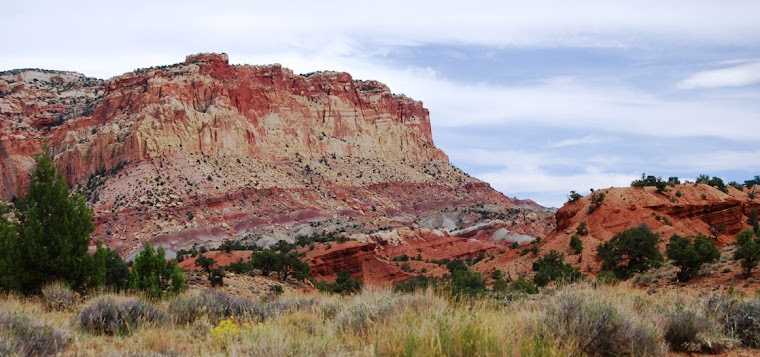
Photo by Sage taken along the Siever River in Utah, July 2007. Today, I'm combining yesterday's Three-Word-Wednesday writing exercise (corridor, subtle & linger) with my Poetry Thursday submission (and I'm not sticking to the "recommended" style today's poem).

Life

At the beginning, the corridor seems endless.
Even if it was possible, there’d be no reason to linger
with a subtle breeze propelling all forward.
Then comes the day we can’t linger even if desired
for the wind is now a hurricane
as the corridor’s end approaches.


Thursday, August 16, 2007

Dawn on the Prairie: A Poetry Thursday Submission


Dawn on the Prairie
Stars fade long before the darkness cease
pending the arrival of one greater
that arises behind a horizontal curtain
of red and purple pleats
and greeted by a winged chorus
hidden in the rustling grass.

Photo by Sage, taken near DeSmet SD