Friday, September 21, 2007

Swamped

I am absolutely swamped… I didn’t get around to doing 3WW this week, nor any of the poetry stuff, and it doesn’t look like I’ll even get enough of a break to do Sunday Scribblings… I'm not doing a very good job keeping up with folks blogs. Oh well, here’s a picture from last month, the road into Leopold’s Cabin along the Wisconsin River. Looking at such roads give me hope.

Speaking of hope, I hope to finish my vacation posts early next week when I report on our stop in Walnut Grove. With OJ back in the news, I wish I had time for satire, but I don't, so I'll refer you to this great quiz about the former running back who seems to have more run ins with the law than he did with defensive tackles. Or I could write about our President’s exit strategy from Iraq, but this poster at Karen’s blog says it all. Or I could do the meme Gautami tagged me on, but I’ll get to that later. It’s about reading and I’ve not had much time for reading. When I do publish that meme, I want to make sure I tag Grundir the Implacable, just because I like living on the edge. And I also should promote Pia’s interview with Jancee Dunn… With all these links, who needs to read my dribble?

Ya’ll take care now, ya’ll here! I'll try to get something original up next week.

Monday, September 17, 2007

Six Days in the Berkshires, 1987


One of my regular readers is getting ready in a few weeks to head to the Berkshires to hike. I’m envious, but since I’ve already covered that ground thought I’d go back to my journals and recreate my hike across Massachusetts back in the summer of 1987. Photo is of Sages Ravine.

Hiking north, I dropped down from Bear Mountain into Sages Ravine where I crossed the Massachusetts line. Its early afternoon on July 13th and I’ve already covered over a dozen miles. The gorge is dark and cool. After a week of hot humid weather and swarms of mosquitoes, it feels good to leave Connecticut behind and the cool air is refreshing. I drop my pack, fill up my empty water bottle from the stream and drop in a purifying tablet. Then I pull out my journal, a copy of Herman Hesse’s Narcissus and Goldman, along with my lunch. I have two cups of steamed rice that I’d made at breakfast along with some slices of cheese and some dried fruit. As I eat, Ben comes along and we chat for just a few minutes. We agreed to meet up again that night at Glen Brook shelter. After eating and reading a dozen pages, I take a nap, only to be awakened by a dog belonging to a young woman out on a day hike. I read some more, then pack up and shoulder my pack and set out northward on the trail. After a short while I run into the woman again, wearing a red swimsuit and coming out of a pool of water. We talk as she dries off and pulls on her boots. Then she joins me as we make our way to Break Rock Falls. Her name is Brenda; she’s from New Milford, CT and is a third year college student, studying Health Education. While at the falls, we begin hearing distant thunder. Brenda and her dog turn around and head back to their car while I keep heading north. A short while later, hiking the ridge between Race Mountain and Mt. Evertt, a strong line of thunderstorms move through. The air turns chilly and the wind blows hard enough to break branches. Luckily it only keeps that up for a few minutes. Then the lightning starts popping around. I pull on a rain parker and with no where to go, keep hiking, praying that my luck will hold out.

The rain stops before I get to Glen Brook Shelter, but the air remains chilly. I quickly changed into dry clothes. Ben is busy sautéing day lilies and offers me a sample. Over the past few days, I’ve gotten to know him a bit. He’s a former government economist who took an early retirement and then went to culinary school. Divorced and with kids grown, he spent the last two summers on the trail and has worked in a variety of restaurants in ski areas during the winter. On the trail he’s known as Luck Ben. I’m the Sojourner.


The next morning I get an early start. After yesterday’s storm, the air is cooler and there’s less haze, but with no overlooks in this section it doesn’t matter much. Late morning, I pause at a rock marker noting the last battle in Shay’s Rebellion, a farmer lead tax revolt that occurred shortly after the revolution. Reagan isn’t the first tax revolutionary our nation has seen and he probably won’t be the last. In the late 18th Century, the government was burdened with massive debt from the Revolutionary War and raised taxes. This resulted in many farmers losing their land and a group of them fighting back, but their fight was quickly subdued by the better trained state militia. I make pretty good time the rest of the day and stop at South Wilcox Shelter, arriving right before the rain. As I fix dinner, I run out of fuel. Ben let’s me use his stove to finish dinner. I’m hoping to get gas tomorrow in Tyringham. I spend the evening reading from a Gideon Bible and more Hesse.

The air feels cold when I wake up on July 15 and my thermometer reads 50 degrees. That’s a good 20 degrees cooler than it’s been being. The wind howled through the hemlocks all night. It feels like fall. The wind and cooler air reminds me that the summer will soon be gone. I get a quick start hiking as a way to warm up and arrive at the Tyringham Post Office at 10 AM, having covered 8 miles. On the road into town, I pass several large estates. According to a southbound hiker, the widow of Nat King Cole lives in one of them. There are no stores in Tyringham, only a Post Office and library. I stop to write a few letters and to update my journal, leaning against my pack which rests on one of the pillars holding up the porch of the post office. There doesn’t seem to be much going on. Felipe, a reporter for the Union News in Springfield, stops by and chats. He’s assigned to write a story on the 50th anniversary of the Appalachian Trail and is hiking the trail through the state. We talk for a while, with him taking notes, and then he shoots a couple of photos of me leaning up against my pack. When he goes into the post office, I take off heading north.

The trail continues along the road heading out of town and I soon run into Scott, Denver Jane’s boyfriend. He’s driven out to help Jane make miles by shuttling her pack and was trying to reconnect with her. I haven’t seen her in several days and assume she’s somewhere behind me. He offers me a cold Mountain Dew from a cooler and we talk a bit. When he asks if there’s anything he can do for me, I mention that I’m out of fuel and he offers to fill my bottle from a can of Coleman fuel he has stashed in his truck. He continues on to find Jane and I make good time, crossing over I-90 and on to the cabin at Goose Pond, arriving at 2 PM. It’s a short day. I take a swim and a nap. When Ben comes in later in the afternoon, he suggests we hitch into Lee for dinner. We don’t get any rides going into town, but it’s only a couple of miles from the cabin and without packs, we make good time. We eat at an Italian place. Ben, the trained chef, is surprised at the quality of the food, especially for the price. When we get back to the cabin, Felipe is there talking to the caretaker. I hike out around the lake and meet Mary, a bubbling redhead who’s staying with family friends at their cabin for a week. She has a canoe and we paddle around the pond as she talks about her plans for college in the fall. The sunset is spectacular. Shortly afterwards, I head back to the cabin and chat a bit with the caretaker. He completed the trail several years ago and now spends his summer running the cabin for the Appalachian Mountain Club. The job doesn’t pay much, but I can image a better way to spend the summer.

The weather remains cool on the 16th and I quickly clock off the 17 miles to Kaye Wood Shelter, arriving there at 3:30 in the afternoon. This is a new shelter named for a former president of the Berkshire Mountain Club. I spend the rest of the afternoon reading Hesse and being surprised with a visit by the shelter’s builder along with Kaye Wood herself. A number of other hikers come in. We all call it an early night and are asleep by 9:30 P.M. when Felipe arrives. He makes a lot of noise getting ready for bed which grates on Ben’s nerves and the two share some unkind words.

Ben wakes up at about 5 AM on the 17th. It’s still pitch dark, but he starts packing up, making as much racket as possible and mumbling about having been awaken in the middle of the night. He’s trying to get back at Felipe, but he’s now getting on my nerves. He leaves while it’s still dark and I fall back asleep for another hour. We all start getting up and I fire up the stove and begin boiling water for tea and oatmeal. When Felipe gets up, I apologize for Ben’s behavior. I’m not sure what the issue between the two of them is, but they don’t like each other. A little later I head out and catch Ben before he gets to Dalton. There we buy food and also share a washer at the laundry mat. With both of us packing light, we have less than half a load between us. I finish reading Narcissus and Goldman. I’m also about out of pages in my journal, so I stop by the post office and mail both my notebook and Hesse home. As we’re getting ready to leave town, Scott comes by in his truck. Jane along with Slim Jim and Big Daddy Longlegs are right behind us, slackpacking. He’s got their packs and offers to take ours and to shuttle them to the hostel in Cheshire. We take him up on it and knock off the eight miles in three leisurely hours, stopping to enjoy the views of the town from the cobbles. After dinner and a few beers in a local restaurant, I spend some time cleaning up my gear and sewing up a rip in my boots up with dental floss. Before bed, I start reading John Steinbeck’s Travels with Charlie, a book that Shari had suggested when she was on the trail. I was surprised at the Post Office in Kent, Connecticut to find a letter from her and a copy of the book.

I wake up on the 18th a bit disgusted, having dreamed about my ex-wife. We’ve been apart for four years, yet this was my third dream about her while on the trail. Nothing about the dream made sense as we were arguing about proceeds from selling a house, but we never owned a house as one or the other of us was a student the whole time we’d been married. Maybe the cause of the dream had to do with Ben complaining to me about his problems with selling a house after his divorce.

The accommodations are good at the hostel and Scott offers to shuttle us up to a county road three miles into Vermont and then let us hike southbound to Cheshire. I take him up on the offer; it’s a chance to do a large number of miles without a pack and will allow me an opportunity to hitch into a town and see if I can find a new pair of boots as mine have been falling apart and are held together with dental floss. Yet, slackpacking has its drawbacks. When backpacking, I’m self contained and don’t have to depend on anyone. When slackpacking, I’m forced to depend on someone else for rides and to watch over my gear. Jane and Ben crawl into the cab of Scott’s truck; Slim Jim, Daddy Long Legs and I jump into the back. We’re dropped off on a dirt road and make good time heading south. After seven miles of fast pace hiking, we reach Massachusetts highway 2. I hitch west into the town of Williamsport where I’ve been told there’s an outfitting store, the rest continue on south. I tell them that I’ll see them in the evening. I find the outfitter, “The Mountain Goat,” which is well equipped, but I don’t find any boots that fit. After eating lunch at burger joint, I start hitchhiking back to the trail and am given a ride by a young woman. Between puffs on her cigarette, from which she keeps flickering ashes out the window, she flirts and invites me to a party on some lake. She promises to drop me off back in Cheshire at night and can’t understand my desire to get back on the trail and not to skip a section. I worry that I might have to jump out of the car, but she finally comes to a stop just beyond the trailhead and after thanking for her the ride, I take off heading up Mount Graylock. The views from the top are beautiful and Bascom Lodge looks to be a nice place to stay with incredible views. The cooler air makes me want to linger. This is the highest mountain I’ve been over since Virginia. I spend an hour or so exploring and napping and talking with a young couple in matching Slippery Rock University sweatshirts. They’re both from the Pittsburgh area but now live in Boston. Afterwards, I head down the trail toward Cheshire and am surprised by a porcupine. He freezes and I move down the trail a ways and wait. After a few minutes, he moves across the trail and goes on, but in the shade I’m unable to get a good photograph.

We all leave Massachusetts in the back of a truck on the morning of the 19th. A half an hour later, Scott drops us off at the same place he did the morning before and we hike north, into the Green Mountains of Vermont. After a day and a half of slackpacking, it feels good to have the pack back on my back.

Note about people: Ben was finishing sections of the trail he hadn’t completed and got off the trail shortly afterwards. We would meet up again in Monson, ME. Felipe made many hikers mad and I seemed to be his only friend. I never saw him after the Kaye Wood Shelter, but when I got back in Pittsburgh that fall, there was a letter from him containing the photo of me as well as copies of his articles. As no one else heard from him, I copied the articles and sent them on to everyone else. Jane was having foot problems by this point in the trail, having lost about half of her toenails. I think she ended up quitting and going home with her boyfriend. Slim Jim and Daddy Long Legs and I hiked together through the Green Mountains. Daddy Long Legs decided that he wasn’t ready to finish the Appalachian Trail just yet, so he hiked the Vermont Long Trail to Canada, then returned to complete the AT a few weeks after me. Slim Jim and I split up in Hanover, NH when I took a day off to shop for boots. We’d meet up again in Berlin, NH and hiked together through Maine. On August 30th, we both climbed Mt. Katadhin, the northern terminus of the Appalachian Trail
Friday, September 14, 2007

Looking for Laura Ingalls, Part 2: DeSmet SD


I’m a little late in getting back to vacation posts—as this was almost a month ago—there’s been too much other stuff going on. Last time, we were looking for Laura Ingalls in the Big Woods of Wisconsin. This post is about our trek out to South Dakota. The picture of DeSmet’s water tower is framed by one of the cottonwoods planted by Charles Ingalls when he homesteaded this property in the 1880s.


DeSmet South Dakota was the highlight of the trip. We spent two nights there, staying on Pa’s quarter section homestead and sleeping in a covered wagon. Well, it wasn’t exactly the same type of wagon that Laura and family traveled in all over the Midwest. It was better. This was a sheepherder’s wagon that had been outfitted with extra bunks. It had a screen door, electricity and included a fan! I don’t know Ma and Pa and the girls did it without a fan, for it came in handy when the wind died. The Ingalls’ homestead is a neat place. During the day they have all kinds of programs designed for kids, teaching them the skills Laura and Ma used to on the Prairie. My daughter had a wonderful time, playing with the animals, attending a one room school, talking to all the workers and showing off her knowledge about Laura. She fed an orphan calf milk, played with barn cats for hours, drove a team of horses, shucked corn among other stuff. Dressed in a pinafore and bonnet, she looked the part running out across the grass. Only her flip-flops gave her away.


Driving from Pepin, we took the fast way to DeSmet, dropping down to I-90 and taking it across Minnesota. I thought it might be fun to stop at the Spam Museum in Austin, MN. After explaining that Spam isn’t only unwanted emails but also a famous yet mysterious form of canned meat, I was quickly outvoted. My daughter is on her way toward becoming a vegetarian anyway and probably didn’t need any encouragement which I’m sure the museum would have provided. If ever I again pass through Austin by myself, I’ll be sure to tour the Spam museum. At least it’ll make a great blogging post and since it’s free, what’s there to lose. I drove on into South Dakota and missed my turn (I was going to take the interstate up to Brookings and then to DeSmet) so I ended up coming to DeSmet from the south, passing by the place where Laura first taught in a one room school. We found the Ingalls Homestead, checked out our wagon adobe, and then heading into town for some evening grub. After dinner, we went back to the homestead and a peaceful evening watching the light change on the prairie. That night, storms rolled through the area, but they were either north or south of us. I went outside and spent half and hour enjoying the lightning show. The air was cool and dry, the sky was big, It felt like I was back in the West.


The next morning, we were treated with a beautiful sunrise. We drove into town for breakfast (it’s only a mile or so away), then came back to do all the stuff at the homestead. After we spent the morning there, we went back into town and spent the afternoon touring the town, going through the Surveyor’s House (where the Ingalls’ lived when they first got to town and was the location for the novel, The Long Winter. We also toured the house that Ma and Pa later built after Pa gave up homesteading, the Depot Museum which is in the old station for the Chicago Northwestern Railroad (now the Dakota, Minnesota and Eastern). The museum also had information on Harvey Dunn. I’d seen his paintings before and liked his style. “The Prairie is My Garden” is his most famous painting, but he also painted many military scenes for the American Legion magazine as well as even some works depicting the human body. We also went to the graves of Ma and Pa and out to the site where Laura and Almanzo first lived. That night, we came back to the wagon for a cookout (I’d brought my smallest Dutch oven and fixed a cobbler to top off the feast).

Pa's Grave in the Ingall family plot.


Our final day in DeSmet was a Sunday. We decided to go to church where Laura attended, so we headed back into town and found the old Congregational Church which is now a Christian and Missionary Alliance Church. The service was okay even though the pastor (who’d been retired for sometime and was filling in) could have been a contemporary of Laura’s. The Ingalls and Wilder’s attended the Congregational Church and Pa helped raise money to buy the church’s bell. Sometime in the past (it looks to be in the 50s or 60s) the Congregationalists built a new church (one of those hideous A-framed churches that was popular back then). The bell that came out of the old church is now on display beside the Congregationalists Church A frame. After church was over, we left DeSmet for Walnut Grove, Minnesota. I hated to leave the prairies, for I knew it meant that I had to go back East, but it was time. I’ll write about Walnut Grove in a future post.
These last photos are of the replica of the Ingalls' "little house" on their homestead and a picture of the land and sky, looking toward the slough where Pa knew he could always cut grass for the animals. For a poem I wrote after watching the sunrise on the prairie, click here.

Thursday, September 13, 2007

A Photo, a Triple 3WW, & a Recipe

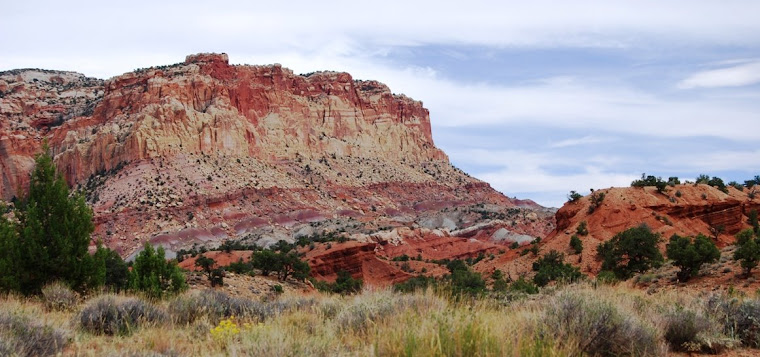
I took the photo last July, while driving south of Mountain Meadows, heading toward Snow Canyon State Park in SW Utah. Note the prominent cinder cone.

Every week Bone provides a writing challenging. Giving us three words, he asks those of us willing to come up with something creative using the three words he provides. This weeks, our three words are “Original, Racket, and Skipping.” I often find myself immediately coming up with something to write—often using all three words in a sentence. This week I wrote three different pieces… “For what?” “I don’t know.”

1. Bill was proud of Ole Blue. “It has all original equipment,” he bragged as we walked through the parking lot. When we got to an older truck that looked like it was hand painted, he slapped the hood as if to let it know he was back, then crawled in behind the wheel. The doors were unlocked, so I jumped in on the passenger said, and he turned the ignition. After a misfire or two, the engine caught; he put in into reverse and backed out of the parking place. Shifting into first, we headed toward the street. “You sure it’s running okay,” I asked. “Its sounds like that the timing is off, like there’s a piston that keeps skipping.” “Nah, everything is fine,” Bill assured me as he pulled out into the street and gave it some gas and shifted into second. When he pushed the gear into third, the engine started making a big racket and then gave off lots of smoke, then ground to a halt, stranding us in the middle of the highway. “Don’t think I’d be bragging any more about its original equipment,” I said as I got out in order to push the truck off the highway.

2. Paula was proud of her record collection, especially the old 78. “It can’t get any better than listening to these originals,” she assured me as she pulled the vinyl out of its cover, blew on it as if to dust it off, and then carefully placed the disk on the turn-table, touching only the center and outside rim. As the record began to spin, she carefully lifted the arm and set the needle on the spinning disk. With such care, I was shocked at how much skipping the needle was doing. Such a racket came out of the speakers that I wanted to scream. “I think I’ll stick to CDs,” I said as I got up and headed for the door, hoping to quickly find a fist full of aspirin.

3. Although it was an original merry-go-around from the pre-OSHA days, the kids at the park preferred skipping rocks into the pond because the ride was so rusty that it made such a racket whenever anyone tried to spin it around.

Gingerbread Recipe

Jadedprimadonna (Angie from SC in my blog list) recently asked for my favorite molasses recipes. This gingerbread recipe came from my Great-Grandma. She was born in the 1880s and died when I was seven. Last year I wrote a post about her and my great-granddaddy. Even though she had a gas range, she continued to use a wood burning stove that sat next to the gas range in her kitchen, especially for baking, until the day she died. This is great with applesauce!)

½ cup butter
½ cup sugar
1 egg
1 cup molasses
2 ½ cups flour
1 tsp cinnamon
1 tsp ginger
½ tsp cloves
1 tsp salt
1 cup hot water
1 ½ tsp soda

Combine butter and sugar. Add eggs and molasses. Shift flour with soda, salt and spices and add to molasses mixture. Add in hot water and stir until smooth. Bake in a 9” x 12” baking pan at 350 degrees till done. I didn’t write a time down, but I start checking on it after about 45 minutes. (Hint: insert a toothpick and when it comes out clean, consider it done).

Tuesday, September 11, 2007

911: Remembering another American Tragedy, Mountain Meadows


I took this photo of the site of the 1857 Mountain Meadows Massacre this summer when I was my way into the Pine Valley Mountains to backpack. The cottonwoods in the valley (middle left) mark the site of the spring where the wagon train had camped.


Today is the sixth anniversary of the World Trade Center and Pentagon attacks. It is also the150th anniversary of another tragedy in our history, Mountain Meadow’s, the largest massacre of a wagon train in the American West. Both attacks were made by supposedly religious folks acting in a zealous devotion to their leader and, as they mistaken believed, to their god.

In 1857, Utah Territory was abuzz with talk of war against the United States. Brigham Young, the leader of the Mormon Church as well as the practical political leader of the territory, encouraged his followers to get ready for an invasion by the American army. That summer, a military detachment lead by Col. Albert Sidney Johnson (later, he would be the Southern General killed at Shiloh) was assembling for their march west, across the plains. Their purpose was to enforce federals laws in Utah, especially polygamy laws, and also to protect the territorial governors and judges who were appointed by the President. In preparation for the pending showdown, Young ordered his followers not to trade with wagon trains passing through the territory for California, but to store up supplies for war. He also allowed the faithful, along with the Paiute Indians, to help themselves to the goods and animals that accompanied the trains. One train that summer had lost 300 head of cattle to raiders. This policy of the Mormon leaders created hardship for those who were making the western journey. Not only were their goods subject to confiscation, they also were unable to trade extra cows for needed stables, especially flour. To make things even more unstable, Mormon leaders had been traveling the territory that summer, preaching fiery sermons designed to excite the faithful to protect themselves and to avenge the death of a Mormon leader earlier that year in Arkansas. With tensions running high, Utah was a dangerous place to be in 1857, especially if you were not a faithful member of the Mormon Church.

The Fancher party, a wagon train of some 120 men, women and children was making its way southwest, through Utah, late at summer. Why they didn’t go the normal route, crossing Nevada and following the Humboldt River is subject to some speculation (the elder Fanchers had made three trips to California, using both the northern and the southern routes. Maybe they were behind schedule and with memories of the Donner party disaster in the Sierra’s early in the fall a decade early helped them decide to take the southern route around the snowy Sierra passes. Or maybe, the grass was better that year along the southern route, or the Natives were thought to be less restless in the South. Both routes were filled with danger, hostile bands of natives along with long stretches without water. Or maybe they had planned all along to head and settle in Southern California. Whatever their reason, their decision to head south through Utah was a fateful one. As Will Bagley notes in his substantial work, Blood of the Prophets, “Once the Fancher party left Salt Lake, it disappeared into a historical maze built of lies, folklore, popular myth, justification, and a few facts.” All the information on the party’s travels came from those either involved in the murder or the cover-up. We can assume that along the way, they continued to try to buy flour and needed stables, but were denied at every town. According to accounts told by those involved in the massacre, the men of the party began to brag about how they’d be a part of those who had slaughtered Mormons at Haun’s Mill in Missouri. Not to be outdone, another bragged to have the gun that shot Joe Smith, the founding prophet of the church. Because most of the party had come from Arkansas, rumor got around that some of the men had been present when Parley Pratt was killed. Pratt was a beloved Mormon leader had been murdered in Arkansas earlier in the year. (The Pratt murder is an interesting side story, as he was killed by his twelfth wife’s legal husband). Other rumors also circulating said that the party had poisoned springs used by the Pauites (a trick the Mormons had used in their war with the Goshutes a few years earlier) or poisoned animals that had died which they knew would have been eaten by the Indians. With tension already running high, such talk and rumors inflamed the situation and the Fancher party pushed hard to get out of Mormon territory.

On Sunday evening, September 6, 1857, the party staggered into Mountain Meadows, a spot known to wagon masters heading south as a place to rest animals and to stock up on grass for the long journey through the Mojave Desert. The predawn hours the next day, Monday, September 7, 1857, Mormon Elder John Lee, accompanied by militia from Cedar City and Harmony who had donned Indian war paint, along with a band of Paiute Indians, attacked. Members of the wagon train quickly grabbed weapons and surprised the attackers by repealing the initial assault, killing one Pauite and wounding a couple others. As day broke, the party circled their wagons, creating a fort, and sent out scouting parties to find the Indians who had attacked them.

The siege of the wagon train continued all week. Attempts by the emigrants to get word and help from other wagon trains following them failed. By Friday, September 11, the Fancher party was tired and running out of ammunition. At this point, John Lee who was now dressed normally, rode in as a savior, saying that he and his men would protect the party from the angry Paiutes and give them safe passage back to Cedar City. Desperate, they agreed to Lee’s terms. His militia (their war paint washed off), collected their weapons and pretended to protect them from the Indians as they divided the party up into groups of men, women and children. The groups were led them toward the north end of the valley and Cedar City. Before they left the valley, the Mormon Indian allies attacked and were assisted by the Mormon militia. Everyone in the party over the age of six was killed.

Supposedly, Lee had previously requested instruction from Brigham Young, asking if he should exterminate the party. Two days after the attack, word came back with the message to let them go. Although Young may not have given the direct word to attack, his rhetoric that summer had created conditions ripe for such a situation. Justice was long coming for the murders. It took years for full details to get out about the attack and by then the nation’s attention was held by the impending Civil War. In 1877, John Doyle Lee, the leader of the Mormons in the South was offered up as a sacrifice. After being found guilty, he was executed by firing squad at the Mountain Meadows site. No one else was charged with the murders of over a hundred men, women and children.

For years, little was known about the attacks. Lots of materials concerning the attacks are missing and there are no accounts from members of the Fancher’s party. Mark Twain had a chapter on the attack in Roughing It. In 1950, Juanita Brooks, a brave woman historian published her research in The Mountain Meadows Massacre. For the next fifty years, her book would be the best source of information on the attack. When I first visited the site in the early 1990s, there was plaque noting that the worst massacre on the overland trail had occurred there in 1857, but there was no suggestion as to who was to blame and one was left to assume it was either Indians or Space Aliens. There was no mention of Mormon involvement and the only mention of the church involved an acknowledgement that members of the Mormon Battalion after having been mustered out of the army following the Mexican War had traveled through the area. In the late 1990s, the LDS Church did install a new plaque, noting the involvement of Mormon settlers, saying they attacked for unknown reasons. In the past few years a number of books have explored the events surrounding the massacre including Will Bagley’s Blood of the Prophets: Brigham Young ad the Massacre at Mountain Meadows (Norman, OK: University of Oklahoma, 2002).