Thursday, February 08, 2007

Mom always taught us to put the interest of others ahead of our own


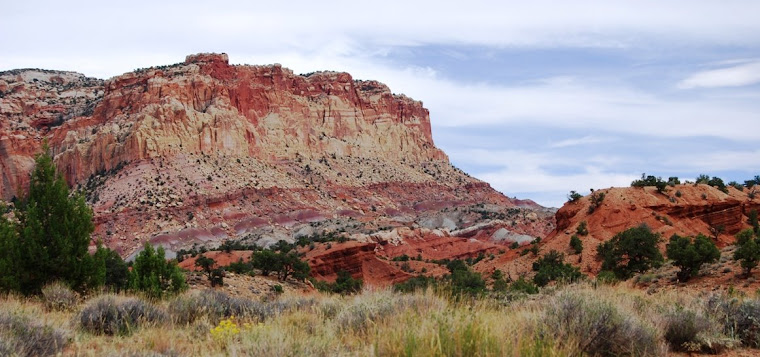
Photo taken a two weeks ago at sunset. It has nothing to do with the story below, which took place when I was probably 12 or 13, although I don't remember the exact year.


“Was it you?” Mom asked as I walked through the door.

“Was what me?

“Did you sign your brother up for old age insurance?”

“Uh,” I hummed thinking.

“Oh yeah, I did.” Smirking, I asked, “Did he get a letter?”

“No, a man came by today. You should be ashamed of yourself. He wanted to talk to W. I couldn’t understand what was going on until he said that he’d received a referral that your brother was interested in insurance. He thought your brother was an old man, not a fifth grader.”

I snickered.

“It’s not funny,” my mother raised her voice a bit. “This guy had a thread-bare coat and drove a rusted out car that smoked and barely ran.”

I tried to wipe the grin off my face as I braced myself for a guilt trip. She continued, telling me how he’d wasted part of his day and his gas in an attempt to sell my brother insurance. She told me how he was just trying to take care of his family and even mentioned his crumpled hat that he held in his hand as he waited at the door. Why did she have to tell me about the hat? I started to feel bad. But not too bad. It takes a while for guilt to set in. It was a good thing I didn’t know anything about insurance as a sixth grader or I’d liable to have told her I was looking out for W best interest as he could get a better rate on old age insurance as an eleven year old.

For just pennies a day, you could get this insurance, the ad promised. I could imagine my brother opening up the package of information, telling about insurance for someone 65 or older. It seemed like such a good idea when I saw the flyer in the Sunday paper. Now I wasn’t so sure. I was expecting some form of punishment but none was forthcoming. Punishment wasn't necessary as guilt washed over me and I suddenly felt responsible for burdening this insurance salesman. Heck, I probably even caused his family to go without dinner that evening. Although I’d never seen any such kids, I’d heard stories from the depression from my grandparents and was sure his kids went to school without shoes. I retreated to my room, did my homework, then headed out to play ball with the guys, hoping to forgot about the man. But occasionally, he continues to haunt me. I never saw him, however I still see him as a lean man in a worn overcoat, standing at our porch. As he waits for the door to open, his hands nervously wring that crumpled hat.

Wednesday, February 07, 2007

What a difference a day makes


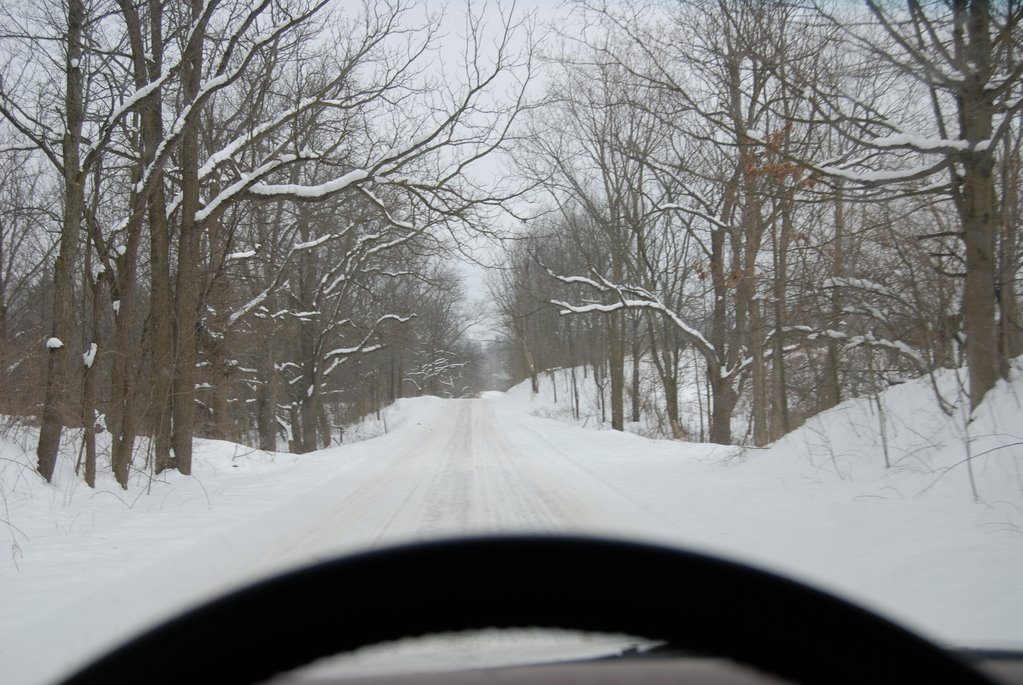
Here I go breaking my rule on writing about family, but this was too cute not to share. The photo was taken on a from behind the wheel going down a secondary county road this weekend.

Yesterday morning I was driving my daughter to school. School had been closed on Monday as we were still getting snow and the low that morning was -15 F (-26 C). By comparison, Tuesday was a balmy 0 F (-18 C), according to the thermometer on my truck mirror. Tuesday morning my daughter was happy and she made up a little song which she sang over and over that went when something like this:

Zippity Do-dah, Zippity Day, it’s only zero out today.

This morning the temperature had dropped back down to -6 F. It was cold; she was running late. I turned up NPR on the radio and as they covered the state news, they listed a number of school districts that were still closed due to weather. This didn’t make my daughter happy and she yelled:

It’s not fair. We only got one day off of school and they’re going to be off all week. That’s not fair!
What a difference a makes. Or maybe it’s the temperature.

Tuesday, February 06, 2007

Crossing to Safety: A Book Review


Wallace Stegner, Crossing to Safety (1987, reprint New York: Modern Library, 2002).

The late Wallace Stegner is one of the great voices of the American West. Not only was he a man of letters, as a teacher he influenced both Edward Abbey and Wendell Berry. Stegner died in 1993, at the age of 83. Crossing to Safety was his last novel. It is the story of two couples, Sally and Larry Morgan and Charity and Sidney Lang. In the heart of the depression, they meet at the University of Wisconsin where Larry and Sidney begin their careers teaching in the English Department. Larry narrates the story which is seen through his eyes.

Crossing to Safety begins in the present. The Morgans have been reunited with the Langs in Vermont, to be by Charity’s bed as she is in the final stages of cancer. In the day they spend together, Larry thinks back over the years they’d known each other, of the joys and sorrows, the hopes and struggles of their lives and friendship. Although sad, it is a very hopeful book. The two were such good friends. Although they accomplish lots in their life (Larry is a novelist), none of them find all their dreams coming true. Yet, they find solace from their faithfulness to one another. They live a good life, despite their problems. Sally developed polio and after the iron lung, never fully regains her ability to get around. Larry is released after only one year of teaching at Wisconsin, a disappointment that leads him into publishing. Sid doesn’t obtain tenure, another disappointment to a young man who inherited a fortune, but was trying to prove himself. He really wants to be a poet, but his wife Charity keeps pushing him further, saying that poetry ought to be a by-product of living, and that “it’s immoral (to only write poetry) and not to get in and work and get your hands dirty.” Charity demands on being in control, a desire she can’t let go of even as she’s dying.

Toward the end of the book, Larry philosophically ponders the end of life as being experienced by Charity and also as have been faced by his wife decades earlier. Having survived polio, she lives like most polio victims, with a capacity to endure. Yet, she also lives knowing that there will come a time that all polio survivors face, when the whole body seems to collapse at once. She learns to live by turning away from such prospects and living life fully. Certainly, the Langs and Morgans lived a full life, creating a very hopeful novel despite the centering event of the book being Charity’s impending death.

A strong point of this book is Stegner’s ability to create a sense of place. You experience not only the people, but the places in which they live. In her introduction to the Modern Library edition, Terry Tempest Williams places this “elegant novel” within Stegner’s “geography of hope.” I agree. By the way, I also highly recommend Terry Tempest Williams memoir Refuge: An Unnatural History of Family and Place.

Check out this novel. It’s good. I’m not sure why it’s taken me so long to get around to reading it. The book is full of hope as the author paints a wonderful picture of two couples living
ordinary but not mundane, fulfilling but not overly fruitful, but always faithful lives.

Saturday, February 03, 2007

More Cross Country Sking


It’s been a cold day. This morning before the wind got to be too strong, I went out with a neighbor skiing behind our houses. If you ski across a field, you can get back into an area where there are the high school cross-country trails and even some old roads. However, there are many down trees, more so than the last time I skiied here.

My dog also went with us. He doesn't like having his picture taken (he's afraid a flash will pop), but I got a backside shot of him. He loves the snow, but after a couple miles was ready to be done as the snow gets into his paws. He had to keep stopping and gnawing out the snow that had become packed into his paws. It was about 5 degrees F, with a wind chill well below zero. It was cold enough that when the wind blew the space between my glasses and hat would sting and give me brain freeze. I’m sure some of you think my brain stays that way. By noon, the wind had picked up extensively, clouds moved back in, and snow was blowing. It was bitterly cold; it was good that I had plenty of work to do inside.


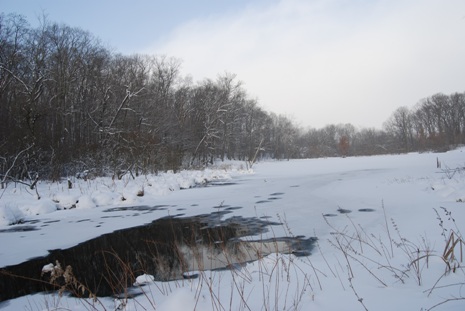
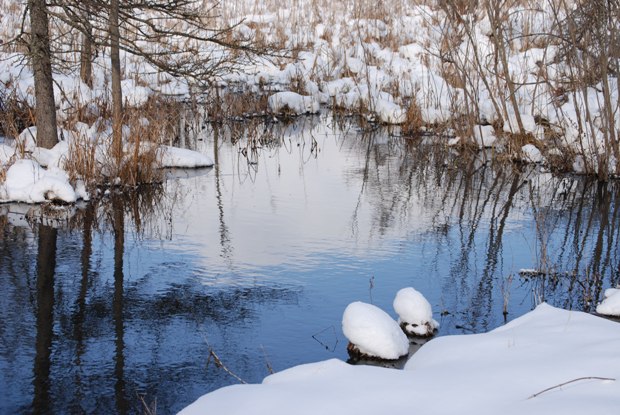
It's amazing that there are still pockets of water that doesn't freeze. There is a spring here that feeds this small pond.

As the ten day forecast has us staying below freezing, I'm hoping there will be more days of skiing.

Friday, February 02, 2007

An afternoon of cross-country skiing


Winter has finally arrived. It’s been cold; we’re in the coldest streak this part of Michigan has seen in a decade (after some of the warmest weather ever). It’s time to make the best of things and get out and ski. These photos are taken around Cedar Creek, south of town at a nature preserve.


Herringboning up a hill.


Look closely for the swans in the middle of the picture to the left.

The skiing was great, except for on the top of some of the hills where blowing wind was bone chilling.