Tuesday, October 20, 2015

Driving West in '88

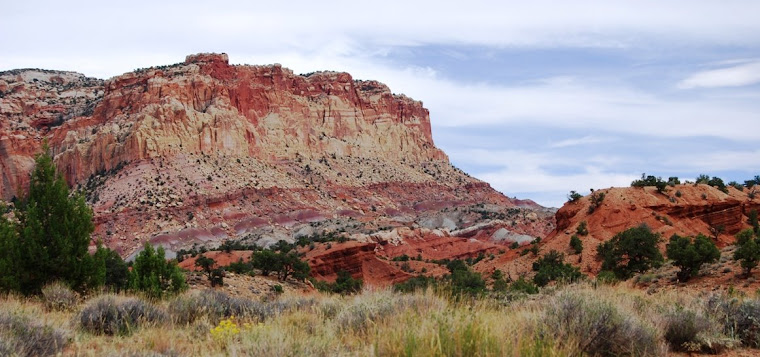
My stomach growls, but I want to make it through the congestion of Kansas City and Topeka before stopping to eat.  It has been five hours since I feasted on bacon and eggs in St. Louis at Homer and Bebe’s, whom I’d stayed with over the night.  Homer was my grandmother’s brother and the relative that lived the furthest west.   I am now on my own.  After saying my goodbyes, I had only stopped for gas and to pick up a new map at the Kansas welcome center. 

This is unfamiliar territory, but ahead of me is a strangely familiar car, a ‘55 Buick with a red body and black top, travelling just a little slower than me.  I turn on my blinker and moved into the left-hand lane to pass.  When I’m beside the car, I look over at the driver who has his elbow sticking out of the window and holds the steering wheel with his right hand.  He’s wearing a white tee-shirt and a beige hard-shelled pith jungle hat.  I quickly take a second look.  Is this an aberration?  The car is identical to the first that I remember riding in and the man driving looks like my dad.  I remember as boy fishing in Dunk’s pond with my dad, him wearing that same style of hat and a white t-shirt.  I wonder what had happened to that car and to dad’s hat as I drive on around the man.  As I speed down the highway, I keep glancing back in my rear-view mirror, thinking about my dad and wondering about that man who could have been his twin.  
  
I decide to stop at the next intersection with a place to eat, but after passing a few with nothing, I decide to gamble on the next town and pull off at Paxico.   There’s nothing at the interchange, but I followed the signs across the Southern Pacific railroad and then, paralleling the tracks, into a small town with a decisively western feel.  Stepping out of the car, I realize that the air is hot and the humidity is building, but I need to stretch my legs.  I walk the length of the commercial district, the few buildings that still exist each having an awning over a wooden sidewalk to shade those passing by.  There’s a old country store that, according to the sign, has been in business since 1901, an antique store and a few other places.  I walk out by the tracks and old depot and watch west-bound freight rush through without slowing down.  Finally, I head back over to the bar and grill.  It’s dark and cool inside and takes my eyes a few minutes to adjust and my sweaty shirt feels cool as I take a sea and order a hamburger.  A radio blares country music between advertisements for farm implements and reports on crop prices.   At the bar, three men in overalls drink beer and discuss the weather, hoping they’d get some rain out of the storms in the forecast for later in the day.  I eat and take it all in.  


Thirty minutes later, after paying my bill, I’m back in the car heading west.  With each mile that I rack up I feel freer.  Later in the afternoon, I watch in fascination as clouds build on the horizon.  I had dreaded this drive across Kansas, but I’m intrigued by these gentle rolling hills and rich dirt.  As the clouds become darker, I notice a bolt of lightning and then another and then it hits.  The wind is tremendous and I hold on to the steering wheel with both hands.  Then comes the rain, racing in sheets across the prairie.  Soon, drops pellet the roof with such force that it drowns out Steely Dan tune playing on a cassette in the car’s stereo.  I slow down and as I drive under an overpass, notice a group of motorcyclists seeking shelter.  But soon, it’s over and steam rises from the highway.  As I pick up speed, I see the car again, up head, the ’55 Buick, and wonder if I’m really alone on this journey.  

Friday, October 16, 2015

Ebenezer Creek Paddle

I am trying to do this on my ipad and have missed some photos and formatting....  But I am traveling with only the ipad, no laptop, so I am a little limited...  


Yesterday, six of us set out to explore Ebenezer Creek, a pristine waterway west of Savannah, known for its bald cypress with huge trunks at their base.  It was a perfect day for paddling, clear skies, highs in the upper 70s.  We put in at Tommy Long Landing and paddled a little over 3 miles down to the Savannah River where we stopped for lunch just downstream of the confluence.  This was a site of an Salzberger community that settled this area in the 1730s.  The Salzbergers were Lutherans from Southern Germany and in the early 18th Century given a choice to convert back to Catholicism, to die or to flee.  They chose the latter and signed up with Oglethorpe who was trying desperately to populate his new colony of Georgia.  Seeing an opportunity at hand, Oglethorpe decided to place the Germans as a buffer between Savannah and the Creek Indians.  There is still an active church in the community, which they say is the oldest building in use in Georgia.  
The steeple is topped with a swan, which has a bullet hole which supposedly came from a Union soldier setting his sights on his gun during the Civil War.  The swam came from a reference to John Hus, an early Reformer from Prague, who supposedly said as he was being burned at the stake for heresy in the 15th Century that he would return as a swan.  Many Lutheran followers saw Luther as the swan who had come back to reform the church.

This is the site of the Old Savannah Road, where a tragedy (or an atrocity) occured in the Civil War.  One of the Union flanks was heading toward Savannah and being hindered by a large following of freed slaves.  The commanding General Jefferson Davis, who ironically shared the name with the Southern President, ordered his soldiers to quickly cross the bridge and then to take it up so that they could be freed by the large group of freed slaves.  Behind Davis' troops was a Confederate calvary who, when approaching, the slaves panicked and jumped into the water.  No one knows just how many drowned.  Accounts range from a dozen or so, to hundreds, to even a  thousand.  

The Savannah River is pretty muddy after all the rain

We had lunch along the banks of the Savannah River and then, thanks to one of our numbers being a Lutheran pastor, we were met by his colleague at the old church for a tour.  In the afternoon, we paddled back to our vehicles for a drive back through Savannah during traffic. 


I'm heading up to North Carolina for the weekend.  Tonight I will attend a football game for my high school and tomorrow I'll be at a class reunion--my first in 3 decades!  What do you have as plans for the weekend?

Monday, October 12, 2015

A pretty good weekend

movie from the comforts of a car!
It was a pretty good weekend.  On Friday, I did a lot of trimming shrubs and yard work.  My daughter and I had plans to go see the new movie, “The Martian.”  When I realized it was on a drive-in theater in Beaufort, we decided for an evening road trip.  I haven’t been to a drive-in since high school and she’d never been one.  It was kind of neat even though they no longer have speakers at each car (now they tell you which station to listen in on your radio).  The photo was taken from the front seat of the car, but you can’t really tell it was from the car (I was hoping to get the steering wheel in the scene but it was too dark).  The movie was pretty good and my daughter thought she preferred the drive-in to regular movies (it was better staying inside the car than to go outside due to the number of bugs outside in the wet ground). 

Close haul

I was supposed to be on the committee boat on Saturday for sailing, but there was rain and some lightning and no wind, so we cancelled.  I did go out on the water with some folks on Sunday afternoon.  Instead of racing, we practiced a number of procedures and generally enjoyed being on the water for a few hours.

Another boat running with a spinnaker 

T. R. presents me with the door prize


Sunday evening, I attended “An Evening with TR” sponsored by the Friends of the Savanah Wildlife Refugees.  There are seven refugees in our area and this was a fundraiser.   Joe Wiegand played T.R. and put on a wonderful show. If he is in your area, I would recommend you seeing him!  In addition to top notch entertainment, I made out nicely as my $20 entry to the lecture resulted in winning one of the door prizes, a $40 book:  The Bully Pulpit: Theodore Roosevelt, William Howard Taft, and the Golden Age of Journalism by Doris Kearns Goodwin.  

Friday, October 09, 2015

'57: the arrival of a cynic

I have been incredibly busy and this will continue for at least the next month.  In addition to work, I am taking another fire department class (pretty soon, if I wanted to which I don't, I could become a paid firefighter).  I am enjoying the class even though it is taking 8-10 a week out of my limited time.  Besides work, I am also taking a class in memoir writing and our first assignment is to write an essay (800 word limit) on the year we were born.  I have to cut this down, but this is my first draft (it's at 1100 words).  What do you think?  My baby picture arrived in blogger upside down, don't know what's up with that but is seemed to go with the theme so I left it that way.


I arrived at the Moore County Hospital, just outside of Pinehurst, on a Wednesday morning in mid-January 1957. The highways through the Sandhills of North Carolina were all paved by then, but many of the county roads were still dirt.  Longleaf pines surrounded the golf courses around Pinehurst and the rest of the county were dotted with small farms raising bright-leaf tobacco that was still mostly cured in barns heated by wood.  It was a simpler time.  The average family income had doubled since World War II and was now was a little over six thousand dollars a year.  It was lower than that in the South, but on paper Moore County appeared prosperous thanks to its numbers being inflated by rich Yankee golfers.  Six thousand could go a long ways as the average house cost $12,000, although furnishing it with a pair of Rembrandt portraits was still out of reach for the most. A pair of his portraits would sell for an even half a million later in the year.  For the non-golfers in the Sandhills, such as my Highland Scot relatives, tobacco was king (and considered safe) and selling for 59 cents a pound.  There were nearly a half million acres of the crop being raised in North Carolina, producing over 1700 pounds an acre.  You can do the math. 

The year began with a meeting of African-American pastors who formed the Southern Christian Leadership Conference.  Wed hear more about them in the next decade, but integration was moving into the forefront and before the year was out, wed have the incident in Little Rock and the Senate under the leadership of Lyndon Johnson would pass the first (but mostly benign) civil rights legislation since the Reconstruction. Wed be hearing more about civil rights and Johnston in the years ahead. 

Two days after my arrival, three B-52s made the first non-stop around-the-world flights and General Curtis LeMay bragged that we could drop a hydrogen bomb anywhere in the world.  The one place we did drop one, accidentally, was New Mexico.  Thankfully, it didn't detonate which is why no one knew about it.  The military were exploding bombs in Nevada but said everything was safe and no one knew differently except for the sheepherders whose flocks began to lose their wool and die off.  There were other nuclear accidents in 57 in the US and UK, but only a few knew about them.  What you don't know won't hurt you, right?  And we all knew our government would never do anything to harm us.

Although there were no major wars going on, the world was tense.  There was the Suez Crisis and the threat of a Soviet nuclear attack loomed.  Our government, working with the Canadians, established the DEW line in the arctic in order to give us six hours warning before the first Soviet bomb could be dropped on an American city  (Canadian cities would have a little less time to prepare).  By the time the work was completed, the margin was cut to three hours as Soviet jets had doubled their speed.  In a few months it all became extraneous as the Soviets launched the first intercontinental ballistic missile.  Later in the same year, they'd launch Sputnik and we'd spend the next decade in a space race. Amidst this, some yo-yo created the first plastic pink flamingo.  The end was near as prophesied by Nevil Shute in his post-nuclear war novel, published in 1957, On the Beach.  I'd read it in high school.

To save us from calamity, we placed our faith in Ike, the President, who many thought I resembled as I too had a bald head. Ike wasnt Herod and didnt waste any time worrying about a newborn impostor as he perfected his golf swing while supposedly preparing himself for a second term as the leader of the free world. 

Jack Kerouac published On the Road in 1957, and people were heading out on the road as a new line of fancy cars with high fins and excessive chrome were revealed.  The 57 Chevy would become an icon of the era as Ike announced the building of interstates to connect the cities of our nation.  Off the radar was an unknown Japanese company, Toyota, with a ship on the sea loaded with their first vehicles for the US market.  People were flying more and taking the train less.  New York City abandoned its trolley cars in 1957, and shortly afterwards the Brooklyn Dodgers (originally named the Trolley Dodgers) announced they were moving to Los Angeles.  The last of Las Angeles trolleys were taken out of service six years later I started the first grade.  Now people think the Dodgers must either be named from their ability at dodging wild pitches or maybe an obscure reference to a Charles Dickens character.  In other sporting news, the University of North Carolina beat Kansas in the NCAA basketball finals.  These teams have remained at the top throughout my life.  The Milwaukee Braves led by a young Hank Aaron beat the New York Yankees in the World Series.  Wed hear more from Aaron and the Yankees, but Milwaukee faded in the next decade when the Braves high-tailed it to Atlanta.  The Detroit Lions, a team whose demise parallels its city, won their last NFL championship.

Ayn Rand published Atlas Shrugged in 1957.  Nearly six decades later, Who is John Galt? bumper stickers are occasionally spotted on American highways.  In the theaters, the Ten Commandments was the top box office success.  For a country that seems so religious, the last commandment about not coveting appears overlooked.  Rand launched a frontal assault on this commandment with her godless "look out for me" philosophy.  Other commandments were also being broken as as the movie Peyton Place, which debuted in theaters, reminded us.      

Radios in 1957 were playing the music of Elvis, Buddy Holly, Debbie Reynolds, the Everly Brothers, Pat Boone and Sam Cooke.  In Philadelphia, love-stuck teenagers danced for the first time on American Bandstand as more and more homes acquired televisions. And in England, two chaps named Lennon and McCarthy met and would go on change music as we know it.  Humphrey Bogart died just two days before my arrival, but it was still a good year for Hollywood.  Not only was Moses selling, but so were dogs as children everywhere cried watching Old Yeller.  Another movie released was the Bridge over the River Kwai which inspired whistlers with its catchy theme music (an old British army tune).  That tune would later be used in a commercial for a household cleanser and then inspired one of the ditties of my childhood:

Comet - it makes your teeth turn green!;
Comet - it tastes like gasoline!;
Comet - it makes you vomit;

So buy some Comet, and vomit, today!

Saturday, October 03, 2015

Happy birthday, Yosemite

On top of Half Dome
Thursday was the 125th birthday for Yosemite National Park.  President Benjamin Harrison signed the legislation to create the National Park on October 1, 1890.  Yosemite stole my heart when I first saw it in 1985.  I drove in from San Francisco with 6 rolls of film (36 exposures each) and by the time I got to the valley where we were staying, I'd taken every frame. 

 I have been back numerous times including having hiked the John Muir Trail (JMT) from Mt. Whitney to Yosemite Valley (over a series of three summers).  I need to make another trip with a digital camera!  I've included a few pictures in honor of Yosemite's birthday.  These were copies of slides.  It really is an incredible place. 

To learn more about Yosemite's beginning and to see an incredible photo of a double rainbow over the park, click here.
 
I haven't been able to visit many folk's blogs over the past two weeks--things are pretty busy on my end and they'll stay that way till probably Thanksgiving.  I will catch up as I can!

Having just completed the JMT